


Over the last two weeks, I’ve been reading Protocols: An Operating Manual for the Human Body. The book is filled with research backed ideas to improve sleep, stress, nutrition, human relationships, and strength. As I’ve been getting deeper and deeper into it, I have connected the dots on one important discovery: all of these areas are regulated and benefited by prolonged engagement with the offline world.
What I mean to say by this is that the reverse, prolonged engagement with the digital world, is extremely detrimental to our bodies. How bad you ask? Let’s see:
The more time we spend online, the worse we feel about our body image.
Extended online use has a direct correlation to depression symptoms.
More time in the interweb disrupts our sleep, social connectedness, brain chemistry, and physical activity.
And finally, it shortens our lifespan by increasing stress and lowering our mood.1
However, it’s not all bad news. Today, I’d like to take the time to explore 3 simple ideas from research papers that remind us that the solution to our online issues is not a new gadget or a new system of productivity. Instead, it is the ridiculously simple practice of spending more time in the real world without the internet pestering our thoughts.

Idea 1: Turn Your Mobile Data Off
Our first stop is a study that shows how something so simple as a toggle on your phone can, and I’m not exaggerating, change your life. Researchers published a paper a year ago where they asked people to turn off their mobile data for two weeks.
They didn’t ask participants to go get a brick or install an app, switch to a dumbphone, or buy a lockbox. All they required was to go to the phone’s settings, tap mobile data off, and leave it off for 14 days. The results were surprising, but at the same time, they make a lot of sense. The participants who stayed offline for those two weeks saw their mood improve, their depression symptoms decrease, and their sense of wellbeing, the internal voice we all have saying, “I’m okay. I’m not stressed. I’m feeling good,” go up. Why did it go up? Because their brains had time to process.
See, there is another study, a kind of “sister study”, that shows that the more interruptions you get during your day, the higher your stress levels are. Think of your phone constantly interrupting you and elevating your cortisol levels as a result of having to keep up with too many things. It’s exhausting to just imagine it, let alone live through it. Therefore, the moment when you turn off your mobile data, the interruptions slow down. Your boss cannot ping your email non-stop. Your friends’ meme messages don’t overwhelm you all the time. Your brain, effectively, gets a break period where it can reset.
What I think this study showcases is that our bodies are in a high stress mode all the time as a result of hyperconnectivity. The internet has conditioned us to a prolonged state of fight or flight. As a counter, we can turn off the data during our lunch time, bed time, or after work hours and enjoy the silence just a bit more.

Idea 2: One Weekend Offline
The next part of our journey is to increase your offline intake to at least 72hrs, once per month. A well-known study from 2012 showed that this is the minimum amount of time that it takes your brain to rewire and find creative solutions to many of your life’s issues. A simple visual explanation is found below:
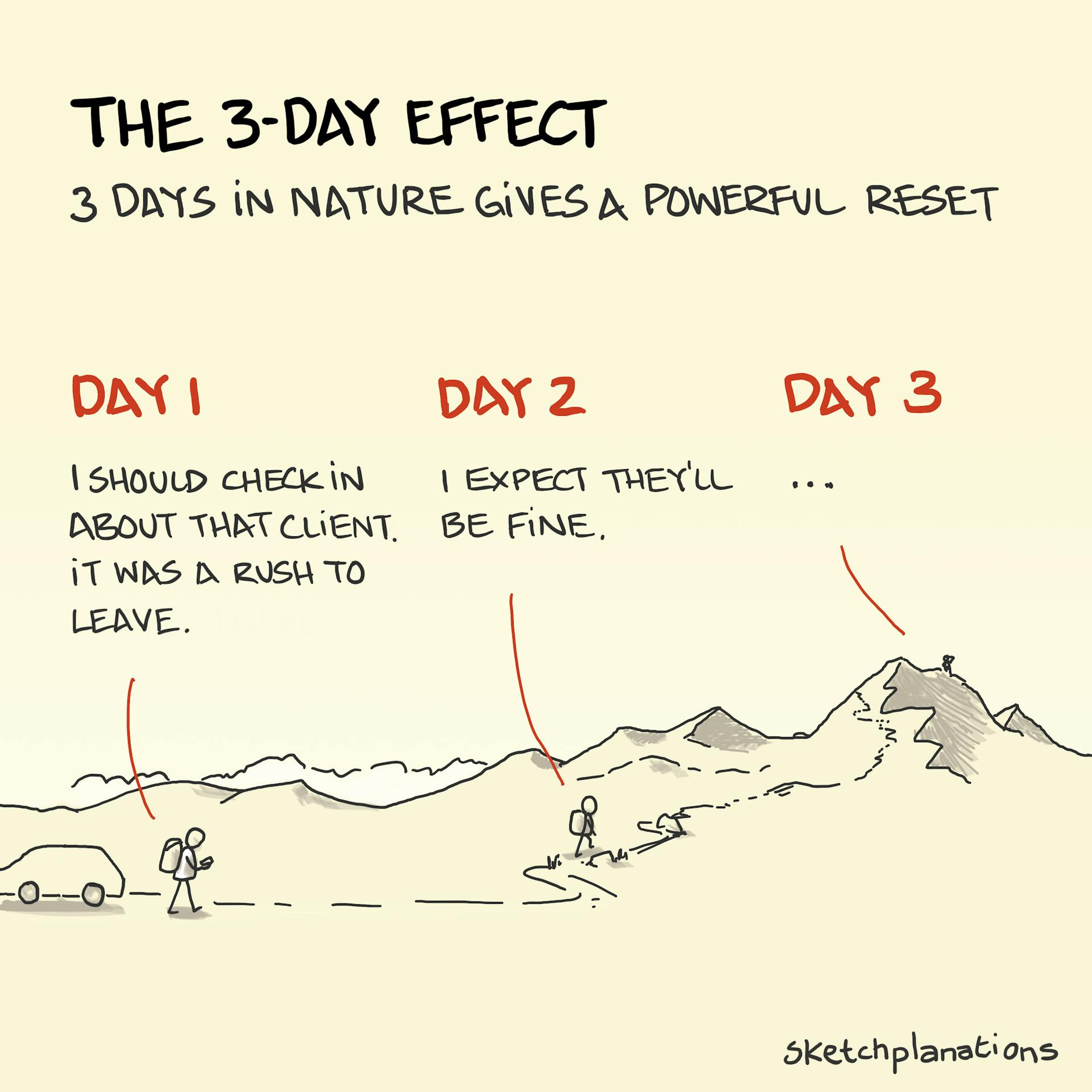
This funny comic corroborates the findings from a different study from 2019 and a recent one that evaluated neural changes in participant’s brains after a three day smartphone restriction period. All of the science points toward the same direction: lowering engagement or completely removing online devices from our lives will help our bodies feel better.
One of the people interviewed in the 2019 study reflected on the experience of traveling without a smartphone and coming back to it: “It was rather disappointing turning my phone back on. Seeing Facebook likes and messages I had, I felt how superficial they were. Not important stuff. I started to think why am I so addicted to counting my likes and reading comments that don’t really have a huge impact on my life? Technology, especially Facebook, has become my life.”
I hope that we learn from their experience and choose to log off more often.
Idea 3: No Phones When People Are Present
The final frontier, and the hardest one I’d argue, is to retrain ourselves to not pull any kind of device when others are with us. Relationship research makes this point impossible to ignore. When you quickly glance into a digital device in the presence of another human (known as phubbing), intimacy, responsiveness, and general relationship satisfaction decrease.
To make matters worse, the mere presence of a phone can increase anxiety and conflict while reducing empathy and conversational enjoyment. Online, indeed, needs to be avoided at all costs when interacting with friends and family.
This scenario is harder than it looks because of how accustomed we’ve become to carrying devices everywhere we go. We have forgotten how to savor a moment and see life through our own eyes. We have, unfortunately, surrendered to a life mediated by a screen instead of experienced through our senses.
It might not seem like a big deal now, but the research shows that when we multitask, our memory capacity decreases. Over time, as we offload more information and delegate experiences to the screen, we might forget more than our mom’s phone number. It could be our vacations, our dinners with friends, or, in outlier cases, lead to total cognitive failure.
Conclusion
Marcus Aurelius once wrote that “the happiness of your life depends upon the quality of your thoughts,” and after two weeks of reading Protocols and digging through the research, it’s clear that our thoughts are being shaped by how much time we spend online.
Every study we went through today points toward the same area: prolonged digital engagement elevates stress, weakens memory, disrupts sleep, dulls our senses, and damages the relationships that make life meaningful. In contrast, extended offline periods restore these factors and help us become better humans.
As I said at the beginning, the solution is not another app or productivity system but a return to offline each day, month, and year. If we want better thoughts, better health, and better lives, we have to give our mind the offline time it was built for.
In some cases, addictive screen use can lead to loss of life.


